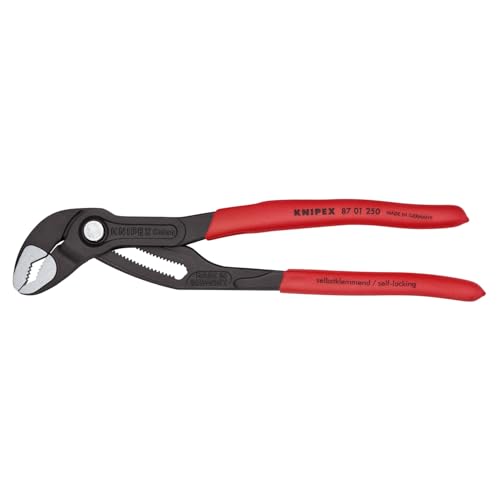
Ask r/Tools which adjustable water-pump pliers belong in a tool bag and the entire thread splits between two brands: Knipex and Channellock. One is the German push-button plier with induction-hardened teeth that plumbers and mechanics swear by; the other is the blue-handled American tongue-and-groove classic that has lived in garage drawers for three generations.
The best one-line summary of the rivalry came from an r/Tools owner who uses both: “I wouldn’t trade my Knipex for anything. However, Channellock makes a better hammer.” If you wrench on pipes, rounded bolts, or machinery regularly, spend the extra fifteen dollars on the Knipex Cobra; if you just need a heavy pair of pliers for occasional household chores, the Channellock 420 or 430 will outlast you for half the cost.
The Knipex case: precision that gets people hooked
Almost every Knipex story on Reddit starts the same way: someone buys a single 10-inch pair of Knipex Cobra pliers to see what the fuss is about, uses them on one stuck fitting, and immediately wants two more sizes. As one convert confessed on r/Tools, “Cobras got me completely hooked on knipex.”
Two mechanical details set the Cobra apart from traditional slip-joint pliers. First, instead of sliding through wide open channels that can jump a groove under load, a spring-loaded push button locks the box-joint into fine teeth with dozens of size positions. Second, the V-shaped jaw geometry and hardened teeth are angled so that once the jaws bite into a round pipe or stripped hex nut, pushing down on the upper handle wedges the jaws tighter by itself. You don’t have to death-grip both handles together to keep them from slipping.
That bite makes the Cobra the go-to rescue tool when a fastener is already chewed up. As one commenter put it on r/Tools, you grab the “Knipex Cobra, for when you absolutely need to unfuck something and you don’t care if it gets trashed in the process.”
Even compared to tool-truck brands, Knipex is priced reasonably at regular retail. An electrician on r/Tools shared what happened after losing a pair at a plant with 60 mechanics: “The ones I need go for $35-$45 at every tool supplier and big box store in my city. The snap on guy was selling them for $80!”
The Channellock case: the classic American staple
For all the German tool enthusiasm online, Channellock remains a staple in American trade bags and home garages for good reason: they are drop-forged in Meadville, Pennsylvania from high-carbon US steel, they cost around $18 to $22 at any hardware store, and you can beat on them without guilt.
Loyalists don’t pretend Channellock is as slim or finely adjustable as a Knipex Cobra; they love it because it is thick, simple, and tough. As one fan wrote on r/Tools, “I am a fan of Channellock! Even if I have to epoxy the handles on. No, seriously I really do love the brand and the tools.”
Because the classic Channellock 420 and 430 have thicker jaws and a beefy overlap joint with no tiny push-button spring to clog with mud or mortar, plenty of plumbers and irrigation techs keep a pair in the truck specifically for dirty trench work, prying, and tapping stubborn parts into place.
Cobra vs Pliers Wrench: don’t buy the wrong Knipex
If you decide to spend Knipex money, pay close attention to a distinction r/Tools brings up constantly: the Knipex Cobra has sharp teeth that chew into metal, while the Knipex Pliers Wrench has dead-smooth parallel jaws that act like an adjustable wrench and a miniature vise.
Comparing the two on r/Tools, one top comment explained: “Cobras are the all-around tool to get first. The pliers wrench is an adjustable wrench and also non-marring parallel-jaw pliers, but not as versatile as Cobras.” Another regular on r/Tools boiled the rule down to ten words: “Cobras for nuts you don’t care about, pliers wrench for ones you do.”
Because the Pliers Wrench squeezes hex flats with a 10-to-1 lever cam and zero backlash, it replaces a whole rack of open-end wrenches and makes traditional adjustable wrenches feel obsolete. As one mechanic joked on r/Tools, “The Knipex Pliers wrench is definitely up there for me. Crescent wrenches only exist for dodgeball training now.” And as another user cautioned on r/Tools, “Cobras are great but if you’re not a plumber there’s no need to fuck up every single fastener you grab,” so if you mostly turn chrome plumbing fixtures or clean hex bolts, pair your Cobra with a Pliers Wrench or keep a smooth wrench handy.
Who should buy which
Buy the Knipex Cobra (10-inch / 250mm, or the 7.25-inch / 180mm) if you work on plumbing, automotive repairs, bikes, or old house hardware where rounded nuts and tight clearances are common. The slim head fits into cramped sink basins where bulkier pliers can’t reach, and the self-locking teeth grip pipe like a pipe wrench.
Buy the Channellock (420 or 430) if you want a rugged $20 American-made plier for general household repairs, yard hydrants, and rough demolition work where you might use the head to tap a staple or pry a bracket.
Plenty of mechanics carry both: a Channellock for dirty pry-and-bash jobs, and a Knipex Cobra for turning stubborn fasteners cleanly.
Who the hype doesn’t fit
When independent test channels like Project Farm run torture tests on water-pump pliers, commenters on r/Tools point out that while Knipex holds up under extreme abuse, you should pick based on the work you do rather than leaderboard scores.
If you open your toolbox three times a year to tighten a garden hose or pull a bent nail, a $40 German plier sits idle 362 days a year. A $20 Channellock will handle every one of those Saturday chores for the next thirty years. Spend up on the Knipex when your hands log enough hours on stubborn hardware to appreciate the thinner profile and harder teeth.
Common questions
Are Knipex pliers worth it? Yes, if you do regular mechanical, plumbing, or DIY work. The push-button box joint never slips a groove, the slim jaws reach into tight spots, and the induction-hardened teeth bite into round pipe without requiring a two-handed squeeze.
What is a Knipex Cobra used for? Gripping and turning round pipes, conduit, stubborn hex nuts, and stripped bolts. Because the hardened teeth bite into the workpiece, avoid using bare Cobras on decorative chrome faucets unless you wrap the fitting first.
Are Channellock pliers any good? Yes. Classic Channellock tongue-and-groove pliers are still made in the USA from high-carbon steel and remain one of the best $20 values in the hardware store.
Knipex vs Channellock, which lasts longer? Both last decades in a home garage. In daily professional trade use, Knipex’s induction-hardened teeth stay sharp significantly longer before wearing smooth.
The verdict
Start with a 10-inch Channellock 430 if you want a tough, no-frills American plier under $25 that can take a beating. Step up to the 10-inch Knipex Cobra (or the 7.25-inch 180mm size for tighter spaces) the moment you get tired of jaws slipping off rounded bolts.
Outfitting the rest of your tool bag? See how r/Tools weighs whether Wera screwdrivers are worth it, the best cordless power tool brand, and drill vs impact driver.